Audit & Assurance Services
Home
Audit & Assurance Services
Independent. Rigorous. Trusted.
AUDIT & ASSURANCE SERVICES
OMAN'S STANDARD FOR FINANCIAL ASSURANCE EXCELLENCE
Oman's Most Trusted Tax Advisory Practice.
When financial integrity matters most, Muscat Audit delivers audit and assurance services that go far beyond signing off financial statements — we provide the independent validation that protects your business, builds stakeholder trust, and positions you for sustainable growth.
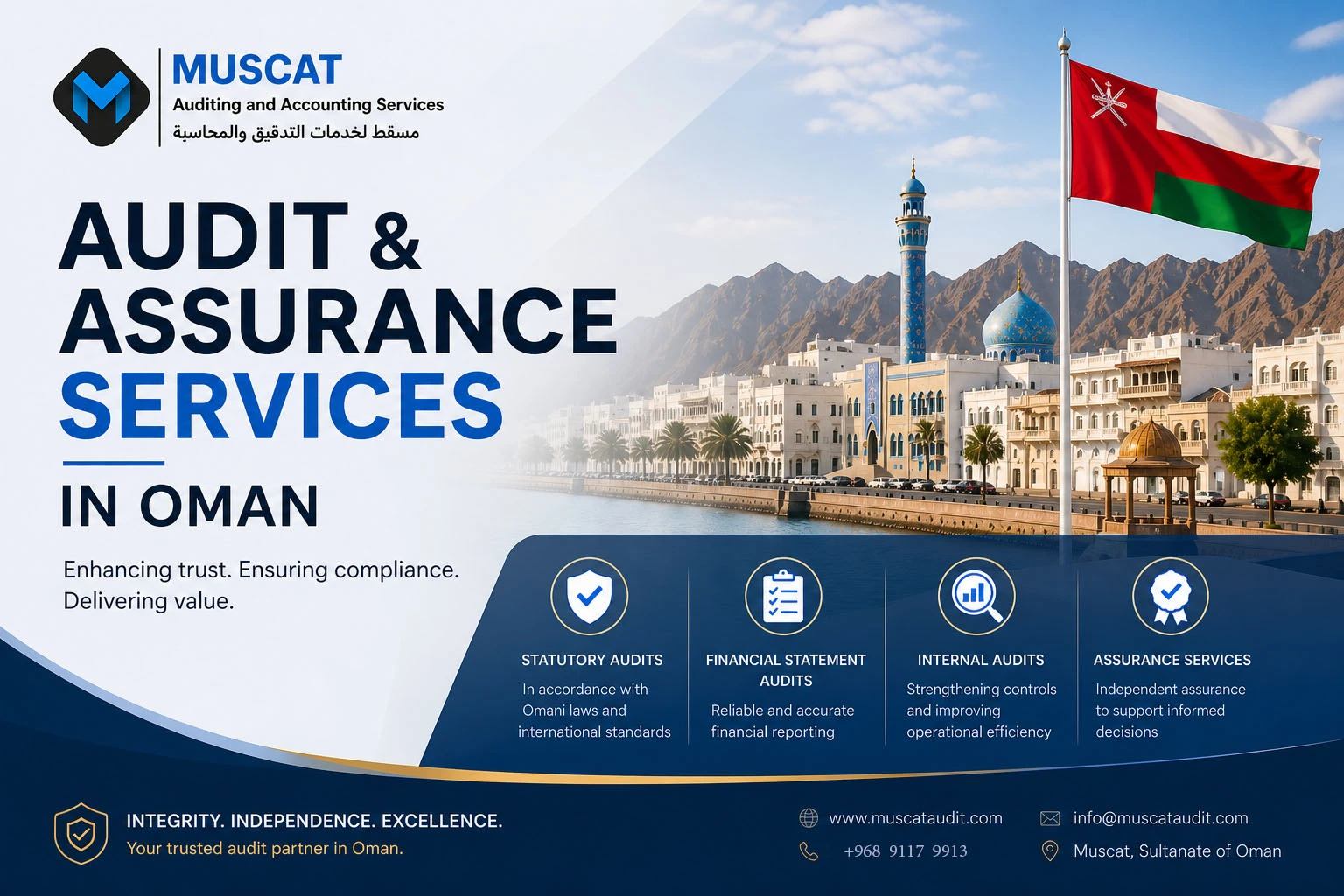
ISA
INTERNATIONAL STANDARDS ON AUDITING
IFRS
REPORTING STANDARD COMPLIANCE
IESBA
CODE OF ETHICS ADHERENCE
IIA
INTERNAL AUDIT STANDARDS

WHY AUDIT MATTERS
The Assurance Foundation Every Oman Business Needs
In today's regulatory environment, financial credibility is not optional — it is the currency of business trust. Whether you are a growing SME seeking bank financing, a large corporate meeting statutory obligations, a government-linked entity reporting to ministries, or a multinational managing cross-border financial reporting, the quality and independence of your audit opinion directly shapes how the world perceives your business.
Muscat Audit's audit and assurance practice is built on one uncompromising commitment: to deliver audit opinions that are technically sound, independently formed, and commercially insightful. Our auditors are not box-tickers. They are experienced professionals who understand your industry, your risk environment, and the regulatory landscape in which you operate — and they bring that understanding to bear on every engagement they lead.
In Oman, the obligation to undergo an annual statutory audit applies to all limited liability companies (LLCs), joint stock companies, and branches of foreign entities with a registered presence in the Sultanate. Non-compliance can result in penalties, difficulties renewing commercial registrations, and the erosion of credibility with banks, regulators, and business partners.
0
+M
Assets Audited
0
+
Listed Companies
0
+
Industry Sectors


2
k
Audit and Assurance Services
"Financial credibility is not optional — it is the currency of business trust."
- All LLCs, joint stock companies, and foreign branches must undergo annual statutory audit
- Audited financials must comply with IFRS and be signed by an Oman-licensed auditor
- Non-compliance triggers penalties and commercial registration difficulties
- Independent audit opinion directly shapes bank, regulator, and partner perception
- Muscat Audit ensures every deadline is met — and every engagement adds real value

Reliable Audits, Trusted Financial Insights
Our expert auditors conduct thorough financial evaluations to identify inefficiencies, mitigate risks, and improve operational transparency.
OUR AUDIT SERVICES
Eight Specialist Audit & Assurance Engagements
Our audit and assurance practice encompasses a comprehensive range of engagements, each designed to address a specific business need, regulatory obligation, or stakeholder requirement.
OUR METHODOLOGY
A Six-Step Audit Process Built
for Quality and Efficiency
Our audit methodology is structured to deliver maximum insight with minimum disruption. Every engagement follows a disciplined, risk-based process aligned with International Standards on Auditing (ISAs).
What Separates a Muscat Audit Statutory Audit from the Rest
IN DEPTH
A Risk-Based Approach, Not a Checklist Approach
Many audit firms approach statutory audits as a procedural exercise — applying a standard template regardless of the specific characteristics of the business being audited. At Muscat Audit, we take a fundamentally different approach. Our audits are tailored to the risk profile, industry, size, complexity, and business model of each individual client.
Before fieldwork begins, our senior audit team conducts a comprehensive risk assessment that evaluates business risks, financial reporting risks, fraud risks, and information system risks. This assessment drives the design of our audit procedures — ensuring that our time and resources are focused on the areas that matter most, rather than distributed uniformly across all line items regardless of risk.
“Our audits are tailored to the risk profile, industry, size, complexity, and business model of each individual client — no two engagements are the same.”
Deep Industry Knowledge That Adds Real Value
Generic auditors apply generic procedures. Industry-specialist auditors ask the right questions. Muscat Audit’s audit teams are organised into sector-focused groups with deep expertise in the industries they serve. Our construction audit specialists understand percentage-of-completion accounting, retentions, and contract-level reporting. Our hospitality auditors understand RevPAR-based revenue recognition, seasonal working capital cycles, and F&B inventory controls. Our financial services team understands provisioning methodologies, regulatory capital, and treasury risk.
This sector depth means our management letters contain actionable, industry-relevant recommendations — not generic observations that could apply to any business in any sector.
“Our management letters contain actionable, industry-relevant recommendations — not generic observations that could apply to any business in any sector.”
Technology-Enabled Audit Procedures
Muscat Audit has invested significantly in technology-enabled audit tools that allow our teams to analyse complete data populations — rather than samples — for key account balances and transaction types. This data analytics capability enhances audit quality, accelerates fieldwork timelines, and enables us to identify anomalies, outliers, and patterns that traditional sampling-based approaches would miss entirely.
For clients with large transaction volumes in areas such as accounts receivable, inventory, fixed assets, and revenue, our data analytics procedures deliver a deeper, more comprehensive audit opinion — without extending engagement timelines or increasing audit fees.
“We analyse complete data populations — not just samples — delivering a deeper, more comprehensive audit opinion without increasing engagement timelines or fees.”
Internal Audit as a Strategic Asset
The internal audit function has evolved far beyond its traditional role as a compliance checker. Today’s leading internal audit practices serve as strategic advisors to management and the board — providing forward-looking insights on emerging risks, governance frameworks, digital transformation controls, and ESG reporting integrity.
Muscat Audit’s internal audit outsourcing and co-sourcing model gives businesses access to a full-spectrum internal audit capability without the cost and complexity of building an in-house function. We design internal audit programmes based on a risk-ranked audit universe, conduct engagements to professional standards (IIA Standards), and report directly to audit committees and boards with independence and objectivity.
“We design internal audit programmes based on a risk-ranked audit universe and report directly to audit committees and boards with full independence and objectivity.”
— THE BENEFITS
Six Tangible Benefits of Choosing Muscat Audit for Your Assurance Needs
— WHO WE ARE
Frequently Asked Questions
Audit & Assurance in Oman —
Your Questions Answered
Under Oman's Companies Law and related regulations, all limited liability companies (LLCs), joint stock companies (SAOGs and SAOCs), and branches of foreign entities registered in Oman are required to conduct an annual statutory audit. Audited financial statements must be prepared in accordance with IFRS and signed by a licensed auditor registered in Oman. Failure to comply can result in penalties, commercial registration renewal difficulties, and challenges in accessing bank financing.
Independence is the cornerstone of every audit opinion we issue. Muscat Audit maintains strict independence policies in accordance with the IESBA Code of Ethics for Professional Accountants. These include annual independence declarations from all engagement team members, conflict of interest screening before accepting new engagements, rotation of audit partners in accordance with best practice, and prohibitions on providing certain non-audit services to audit clients. Our independence policies are reviewed annually by our quality control partner.
Audit timelines vary based on the size, complexity, and readiness of the client's financial records. For small to medium-sized businesses with well-maintained accounts, a statutory audit can typically be completed within three to six weeks from the commencement of fieldwork. For larger organisations with group structures, complex transactions, or multiple business units, timelines are agreed in advance during the planning stage. We work to your reporting deadlines and provide regular progress updates throughout the engagement.
Yes, in most cases Muscat Audit can provide both statutory audit and tax advisory services to the same client, subject to our independence assessment. Where specific independence restrictions apply — such as for regulated entities or listed companies — we will advise you accordingly. For the majority of our clients, the combination of audit and tax services delivers significant efficiency benefits, including reduced duplication of document requests and a more integrated understanding of your financial position.
An internal audit is an independent, objective evaluation of your organisation's internal controls, risk management processes, and governance framework. While internal audit is not legally mandated for all Omani businesses, it is a governance best practice strongly recommended for organisations of all sizes. For businesses experiencing growth, operational complexity, or regulatory scrutiny, a structured internal audit programme provides early warning of control failures, fraud risks, and process inefficiencies — before they become costly problems.
Muscat Audit serves clients across virtually every sector of the Omani economy, including construction and real estate, oil and gas services, hospitality and tourism, retail and trading, manufacturing, financial services and Islamic finance, healthcare, education, technology, logistics, and government-linked entities. Our sector-specialist audit teams bring industry-specific knowledge to every engagement, ensuring that our audit procedures, management observations, and recommendations are grounded in the operational and commercial realities of your particular industry.
Muscat Audit maintains the highest standards of data confidentiality and information security across all client engagements. All team members sign confidentiality agreements as a condition of employment, and client data is stored and transmitted using secure, encrypted systems. Our information security policies are aligned with international best practice. Client information is never shared with third parties without explicit consent, except where required by applicable law or professional standards.
Getting started with Muscat Audit is straightforward. Simply contact us via email at info@muscataudit.com or through the contact form at muscataudit.com. One of our audit partners will arrange a complimentary initial consultation — at no cost and with no obligation — to discuss your audit requirements, timeline, and any specific concerns. Following the consultation, we will provide a detailed engagement proposal and fixed fee quotation. The entire process from initial contact to engagement commencement typically takes less than two weeks.
Get Started
Your Audit Deserves
Better Than a Checkbox.
Request a free, no-obligation consultation with one of our audit partners — and discover the Muscat Audit difference.
Request a Free Consultation